

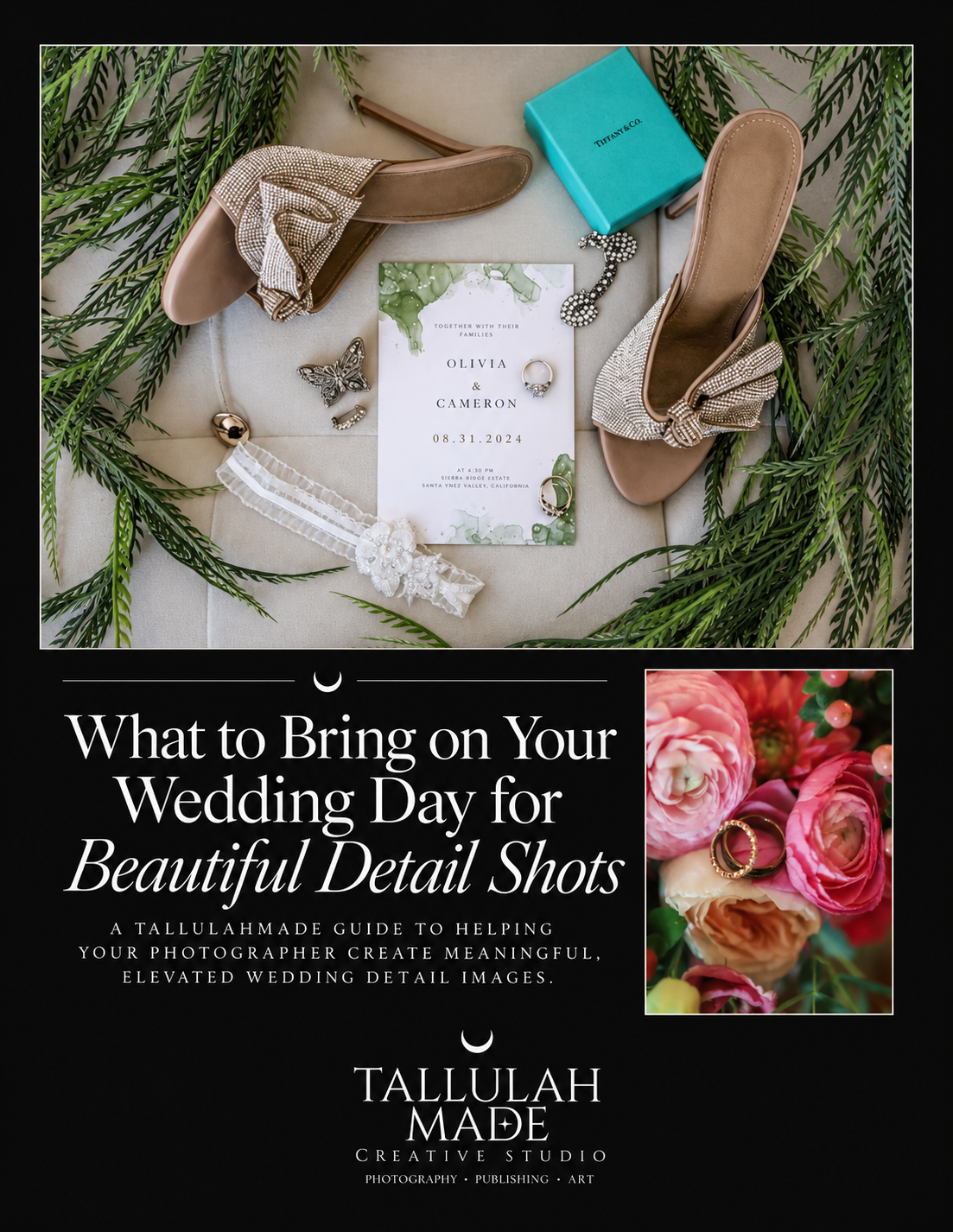
When people think about wedding photography, they usually imagine the big moments first: walking down the aisle, the first kiss, the first dance, champagne flying across the dance floor, or the portraits that eventually end up framed in your home. Those photographs absolutely matter, but some of the images that become surprisingly meaningful years later are often much quieter. They are the photographs of the things you touched, wore, carried, chose, inherited, wrote, and carefully packed before the day ever began.
Wedding detail photographs preserve those pieces. Your rings, invitation suite, shoes, perfume, jewelry, vow books, flowers, letters, heirlooms, and other personal objects become part of the visual story of your wedding. Some of those things may be used only once. Flowers eventually dry. Perfume bottles empty. Invitations disappear into boxes. Shoes get tucked into closets. Jewelry gets worn again in a completely different context. A handwritten letter may eventually soften at the folds. Photography gives those objects a permanent place in the story.
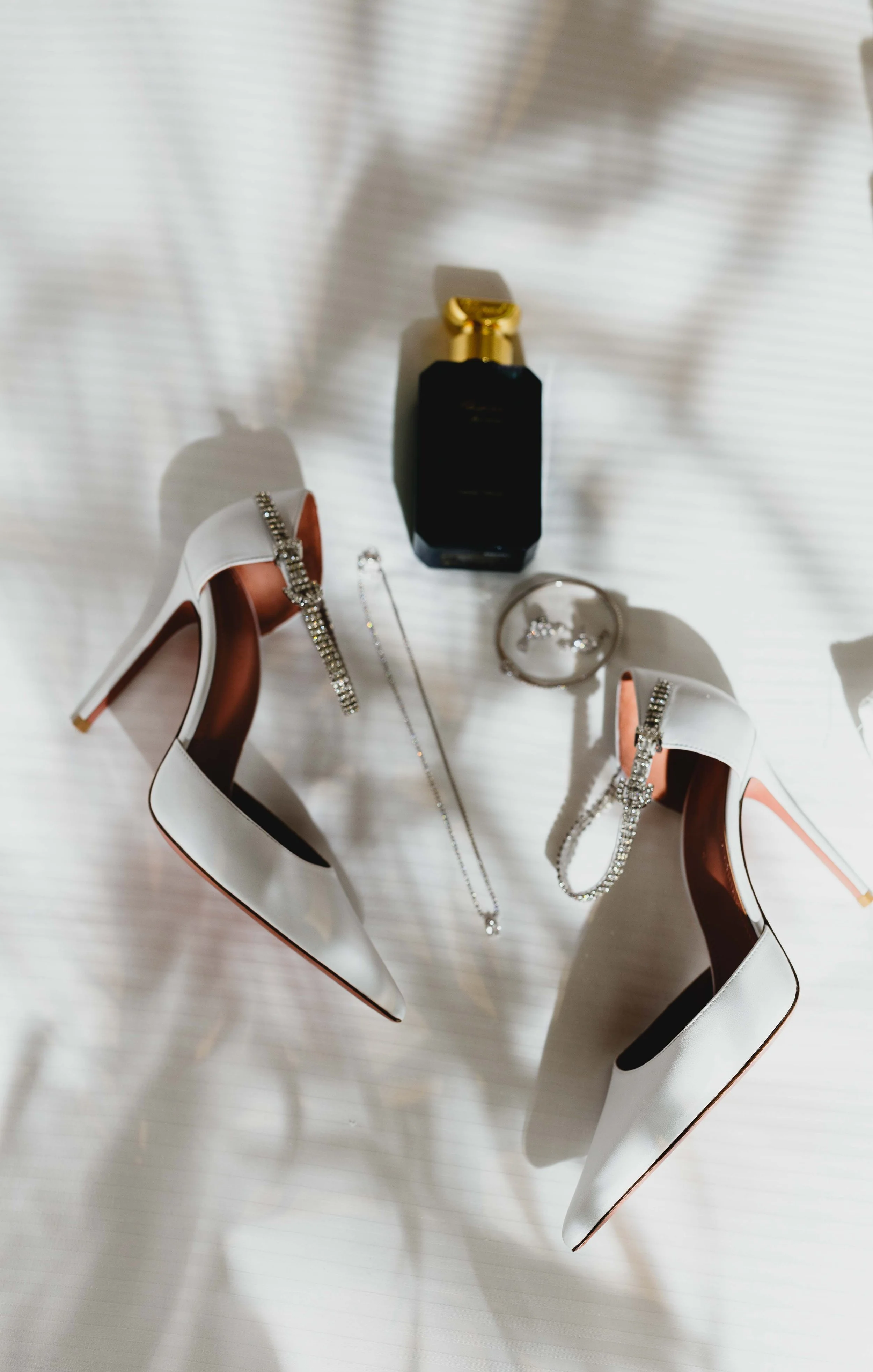
At TallulahMade, I approach wedding details as more than decorative photographs. They are part of the opening chapter of your wedding gallery. They introduce the colors, textures, personality, atmosphere, and little decisions that made your wedding uniquely yours.
What Exactly Is a Wedding Detail Shot?
Wedding detail photographs are close-up or styled images of the objects connected to your wedding day. Sometimes they are photographed individually, and sometimes several pieces are arranged together in what is commonly called a flat lay.
A flat lay is photographed from above, with the objects intentionally arranged into a composition. Invitations, rings, jewelry, florals, ribbon, shoes, perfume, and other elements can be layered together to create one larger image that represents the aesthetic of the wedding.
But not every detail photograph needs to be a flat lay.
Your rings might be photographed nestled inside your bouquet. Your shoes may be photographed beside your dress. A handwritten letter might be photographed in your hands just before you open it. Your grandmother's brooch may be photographed pinned inside your gown. Your partner's watch might be photographed while they are fastening it onto their wrist.
Some details deserve to be styled. Others deserve to simply exist exactly where they naturally belong.
The goal is not to create a collection of random pretty objects. The goal is to create photographs that feel connected to the rest of your wedding.
Why Wedding Details Matter
Think about how much thought goes into the smallest parts of planning a wedding. You may spend weeks selecting invitations, deciding between two pairs of earrings, searching for the right shoes, choosing flowers, having something engraved, or figuring out how to incorporate an heirloom from someone you love.
Those decisions may seem tiny compared with choosing a venue or planning the ceremony, but together they create the visual language of the day.
The invitation suite may introduce your color palette. Your florals bring texture and movement. Jewelry can connect your wedding-day look to your family history. Your perfume becomes tied to a particular memory. A pair of cufflinks may have been a gift from a parent. A letter exchanged that morning may contain words you never want to forget.
Detail photographs give those pieces context inside your final gallery.
They also help create rhythm when your wedding photographs are viewed as a complete story. Instead of moving immediately from getting ready to the ceremony, your gallery has an introduction. The details establish where we are, what the day feels like, and what matters to you before the larger moments begin.
That is especially important when creating albums. Detail photographs act almost like punctuation. They allow the story to breathe between emotional moments and help connect one part of the day to another.
What Should You Bring for Wedding Detail Photos?
You absolutely do not need to bring everything on this list. Your wedding is not a scavenger hunt, and you should never feel as though you need to purchase extra objects simply because they photograph well.
Start with what you already have and what actually belongs to your story.
For paper goods, consider bringing a clean copy of your invitation suite, including the invitation, envelopes, RSVP card, save-the-date, ceremony program, vow books, menu card, or any other stationery that was designed specifically for the wedding. If your envelopes have beautiful calligraphy, stamps, wax seals, liners, or other special details, bring those too.
For accessories, gather all of the wedding rings together if possible. That usually means the engagement ring and both wedding bands. You can also include your ring box, earrings, necklace, bracelet, hairpiece, veil, shoes, watch, cufflinks, tie, bow tie, pocket square, or other accessories.
Perfume and cologne also photograph beautifully, particularly when the bottle itself complements the styling of the day. Beauty products can be included if they are meaningful to you, but you do not need to hand your photographer your entire makeup bag. One beautiful lipstick or signature fragrance can tell the story without creating clutter.
Then there are the sentimental pieces, and these are often my favorites.
Bring letters you exchanged with one another. Bring a photograph of a loved one who cannot be there. Bring your father's cufflinks, your grandmother's pearls, your mother's handkerchief, a charm attached to your bouquet, a family Bible, an inherited ring, a small keepsake, or the strange little object that nobody else understands but means everything to you.
If it matters to you, bring it.
It does not have to be expensive. It does not have to coordinate perfectly with the wedding colors. It does not have to look like something you saw on Pinterest. Meaning will always photograph better than something included simply because you thought you were supposed to have it.
Ask Your Florist for a Few Loose Blooms
One of the easiest ways to connect your detail photographs to the rest of your wedding is through florals.
Ask your florist whether they can provide a few loose blooms, pieces of greenery, or small floral trimmings that match your arrangements. These do not need to be full stems or expensive additions. Florists often have small pieces left while assembling bouquets and arrangements.
Those loose florals can be used to frame an invitation, add color around the rings, create texture beside your perfume, or visually connect your flat lay to your bouquet and ceremony florals.
This is a small detail that can make the finished photographs feel much more intentional and cohesive with the rest of your gallery.
Keep Your Paper Goods Flat and Clean
Paper photographs beautifully, but it also remembers everything that happens to it.
If you want your invitation photographed, try to keep one clean set separate from the copies that have traveled through the mail. Place it somewhere flat before the wedding so it does not arrive folded, bent, stained, or crushed beneath everything else in your getting-ready bag.
You can even set aside one complete invitation suite specifically for photography before mailing the rest.
Do not worry if your stationery is simple. A beautiful detail photograph does not require elaborate letterpress invitations or handmade paper. Good composition, light, texture, and thoughtful styling can make simple stationery feel incredibly elegant.
Put Everything Together Before Your Photographer Arrives
This might be the most practical tip in this entire post.
Place your detail items together in one box, bag, tray, or designated area before your photographer arrives.
Wedding mornings move quickly. Hair is being finished. Makeup artists are packing and unpacking products. Bridesmaids are steaming dresses. Someone is looking for earrings. Someone else is asking where the marriage license went. Phones are ringing. Flowers are arriving. People are walking in and out of rooms.
The last thing you want to spend your wedding morning doing is searching through five suitcases for the second wedding band.
Having everything together allows me to arrive, greet you, assess the room and light, and begin photographing without disrupting what is happening around you.
It also gives me more time to actually create.
If I have twenty minutes allocated for details and spend ten of those minutes trying to locate the invitation, rings, perfume, and earrings, that changes what I can produce. If everything is ready, that same time can be spent experimenting with composition, moving into better light, incorporating your florals, photographing individual pieces, and creating a more complete collection.
Preparation does not make the photographs feel less spontaneous. It simply gives us more room to be intentional.
Your Partner Has Details Too
Wedding detail photography should not automatically mean photographing only the bride's belongings.
Your partner's accessories are part of the day as well.
That may include a watch, shoes, cufflinks, tie, bow tie, boutonnière, jacket, belt, cologne, pocket square, jewelry, letters, gifts, family heirlooms, or something unique to them.
Sometimes those details reveal personality more clearly than anything else.
Maybe your partner is wearing an old watch passed down from a grandfather. Maybe the cufflinks are engraved. Maybe there is a photograph hidden inside the jacket. Maybe they are wearing boots they have owned for ten years instead of brand-new wedding shoes.
Those pieces belong in the story too.
And whenever possible, I also photograph details being used rather than only arranged. Hands fastening cufflinks, tying shoes, securing a necklace, adjusting a veil, buttoning a jacket, spraying perfume, or opening a letter add life to the visual narrative.
Sentimental Details Will Matter More Than You Think
There is a very good chance that years from now, one of your favorite detail photographs will not be the most visually perfect one.
It may be a photograph of your mother's hands helping you fasten a bracelet.
It may be the handwriting on a letter.
It may be your father's old watch.
It may be a photograph tucked inside your bouquet.
It may be something belonging to a grandparent who passed away.
Weddings are strange little intersections of past, present, and future. You are creating something new while carrying pieces of your history into it. That is one reason heirlooms and sentimental objects hold so much weight on a wedding day.
Tell your photographer about those things.
Do not assume we will automatically know that the tiny charm attached to your bouquet belonged to your grandmother or that the handkerchief in the corner of the room is three generations old.
When I understand the meaning behind something, I can photograph it with that meaning in mind.
Your Details Do Not Need to Look Like Pinterest
This one is important.
You do not need luxury shoes, an elaborate invitation suite, designer perfume, custom wax seals, silk ribbon, or expensive jewelry to have beautiful detail photographs.
There is an entire corner of the wedding industry built around convincing couples that every photograph needs another thing in it.
It does not.
Sometimes restraint creates the strongest image.
A wedding band sitting against the texture of a bouquet can be enough. A pair of earrings resting on the handwritten vows can be enough. Your shoes beside the window can be enough.
The objects should support the story, not overwhelm it.
Your wedding details should look like your wedding details, not like a collection of props purchased because social media said you needed them.
If your wedding is colorful, let it be colorful. If it is dark and romantic, embrace the shadows and deeper tones. If your wedding is whimsical, strange, gothic, glamorous, minimal, vintage, bohemian, garden-inspired, modern, traditional, or somewhere beautifully in between, your detail photographs should reflect that.
That is where photography becomes more interesting than simply recreating the same flat lay at every wedding.
I May Borrow From the Environment
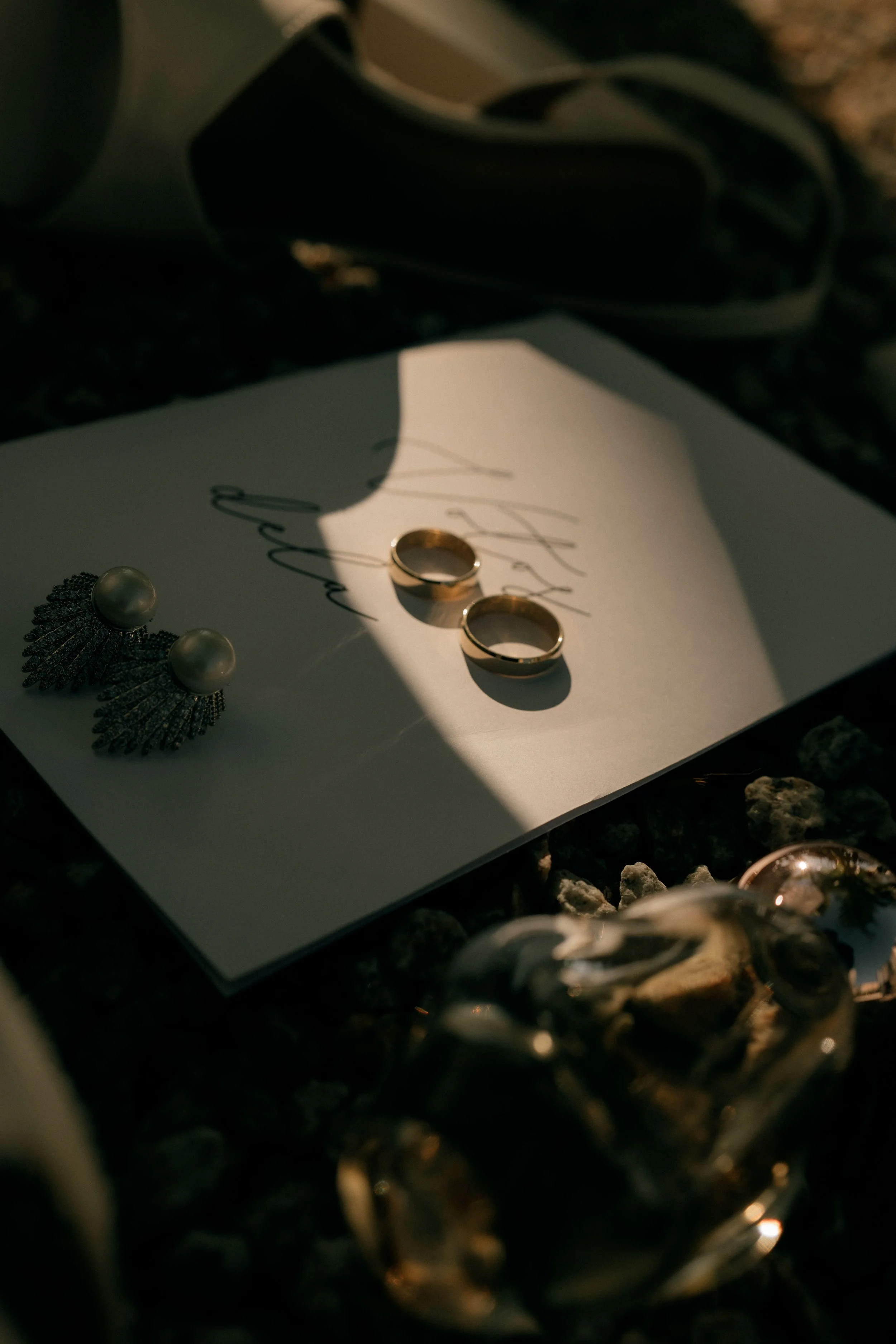
Not everything used in a detail photograph necessarily comes from your detail box.
Part of my job is looking at the environment around me and figuring out what belongs in the photograph.
A textured chair, stone surface, wooden table, piece of fabric, mirror, window light, greenery, curtain, architectural feature, or even something from the room may become part of the composition.
At an outdoor wedding, I may incorporate elements of the landscape. At a historic property, the textures and furniture may help establish place. At a modern venue, a cleaner composition may make more sense.
I want the photographs to feel as though they could only have been created at your wedding.
That is very different from arriving with the same styling board, same ribbon, same ring box, and same formula for every couple.
Give Detail Photography Enough Time
Good detail photography takes time, particularly when several meaningful objects are involved.
I generally prefer to photograph details near the beginning of coverage while the final stages of getting ready are happening. This creates a natural workflow. While makeup is being finished or everyone is settling into the morning, I can photograph the quieter pieces before moving into candid getting-ready images and portraits.
This is another reason having everything ready is so helpful.
The more organized the details are, the less time we have to take away from the people and moments happening around you.
And that balance matters to me. I love creating beautiful flat lays, but I will never value a perfectly arranged invitation more than an actual moment unfolding in front of me.
The details are part of the story. They are not the entire story.
What If You Forget Something?
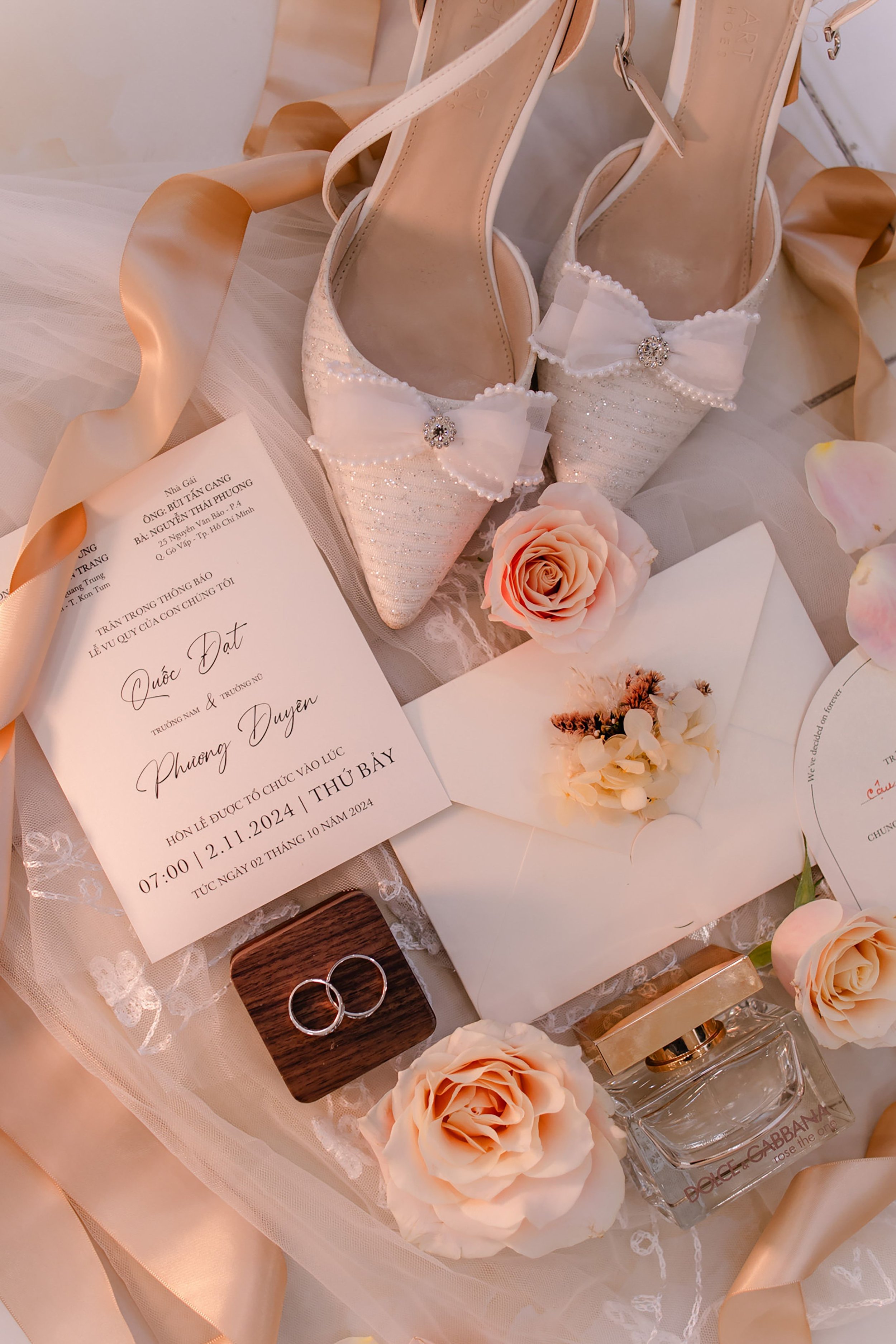
Then we photograph what we have.
Wedding days are living, moving things. Something will probably be in the wrong room. Someone may already be wearing the earrings. The invitation may have been left at home. The florist may forget the loose blooms.
Nothing is ruined.
There are always other ways to photograph the day beautifully.
I would much rather photograph a wedding authentically than create stress over a checklist. The checklist is there to help you prepare, not give you another thing to worry about.
The Little Things Help Tell the Biggest Story
Years from now, you may not remember exactly where your earrings came from or how long you spent choosing the invitation font.
But a photograph has a funny way of bringing everything back. You see the perfume bottle and remember getting ready that morning. You see the rings and remember how strange it felt to finally put them on.
You see your grandmother's jewelry and suddenly remember her.
You see the invitation and realize those names and that date were once just plans printed on paper. Then the day happened. You lived it. That is why I photograph the details. Not because every wedding needs a perfectly styled flat lay. Not because your shoes need their own portrait. Not because the wedding industry says these photographs belong on a checklist. I photograph them because they were there.
Because you chose them.
Because some of them carry history.
Because they help establish the color, atmosphere, and personality of your wedding.
And because the smallest things have an incredible way of becoming meaningful once enough time has passed.
At TallulahMade, my approach to wedding photography is centered on creating photographs that feel intentional, cinematic, romantic, and alive while still preserving the real story underneath all of it. The sweeping moments matter, but so do the tiny ones. Your wedding deserves both.
Stock Image credit: Galina Kolonitskaia, Alex Vo,
